
FIU Law’s historical mission is rooted in serving the citizens of the State of Florida by providing access to a contemporary, high-quality program of legal education. Core to delivering on that mission is training future lawyers who understand the importance of economic freedom and the rule of law, both in representing individual clients and establishing public policy. Nowhere are those values honed more sharply than in the experiential learning opportunities provided in the College’s clinical and advocacy programs, some of which themselves arose from the communities FIU calls home.
The Names on the Walls
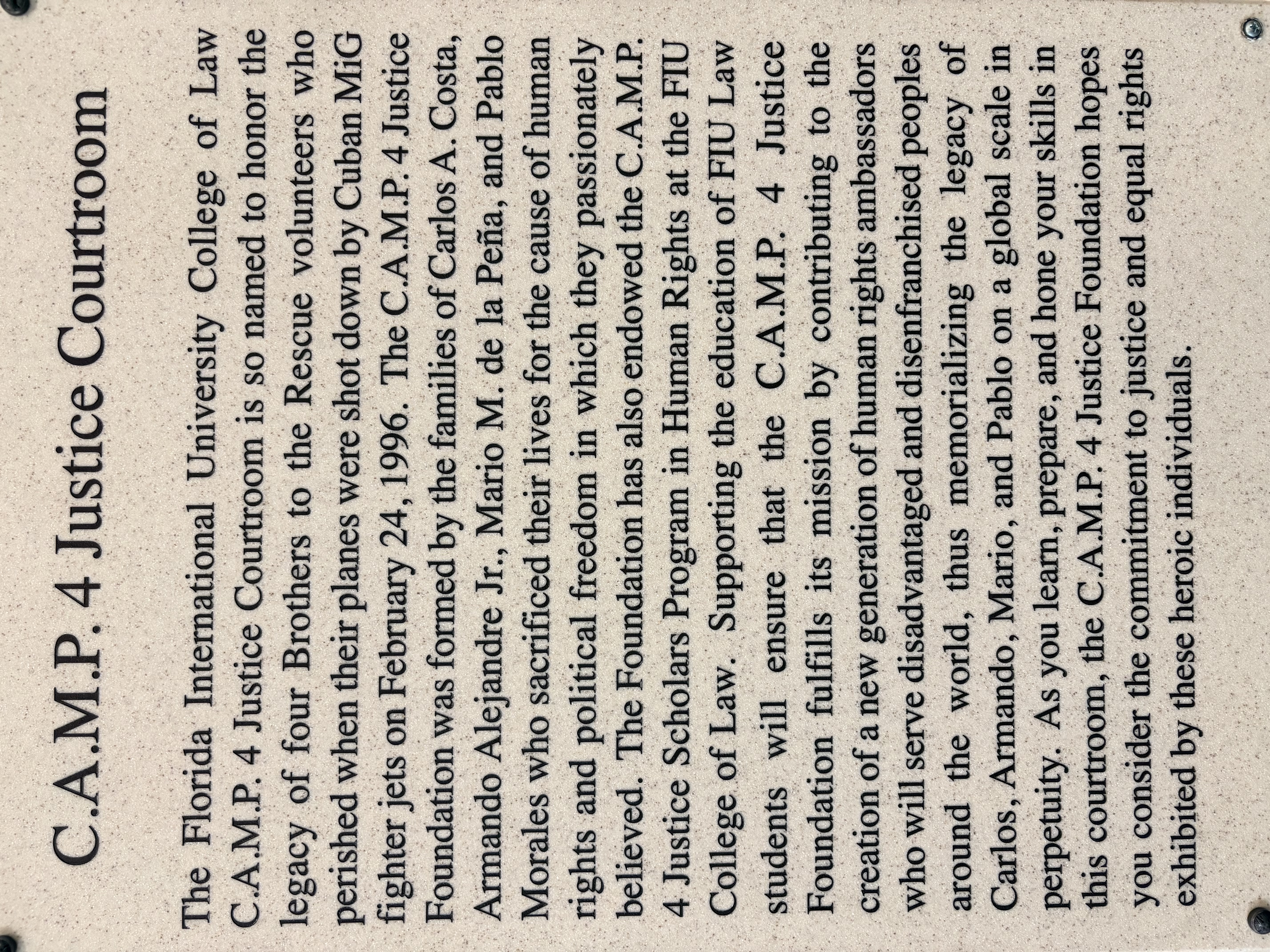
On February 24, 1996, Cuban Air Force jets deliberately targeted and destroyed two civilian aircraft over international waters, killing Armando Alejandre Jr., Carlos A. Costa, Mario M. de la Peña, and Pablo Morales — members of Brothers to the Rescue, a humanitarian organization dedicated to rescuing Cuban refugees at sea and supporting the efforts of the Cuban people to free themselves from dictatorship through active non-violence.
At FIU Law, their legacies are memorialized in the C.A.M.P. 4 Justice Courtroom — named for the four men using the initials of Costa, Alejandre, Morales, and de la Peña — a working courtroom where students argue cases and train in the craft of advocacy. Similarly, the Carlos A. Costa Immigration and Human Rights Clinic at FIU Law is named in honor of Costa, who with his three brethren was peaceably searching international waters for would-be refugees at sea when he was murdered by the Cuban government.
Training Lawyers to Do the Work
Students in the Carlos A. Costa Immigration and Human Rights Clinic interview, prepare documentary evidence, draft briefs and motions, conduct examinations during hearings, and file appeals before various administrative agencies. Working under the supervision of licensed attorneys, this professionally demanding and procedurally rigorous work covers more than 280 hours of training over the course of a semester. Since its founding in 2004, the clinic has helped secure proper legal representation for thousands of people facing federal administrative proceedings.
This clinical work emphasizes the importance of due process and the proper functioning of the legal system, and students who train in this environment learn to ensure that legal proceedings are conducted as the law requires: with evidence fairly presented, rights appropriately preserved, and the full weight of procedural protection applied.
As a result, FIU is able to produce lawyers who have already appeared before federal agencies and argued in administrative proceedings before receiving their degrees. Professor Juan Carlos Gómez, who has directed the clinic since 2010, frames the mission in those terms. "This clinic is fundamentally about the rule of law," he said. "Every client who comes through our doors is entitled to have their case heard properly, with competent representation, before a neutral decision-maker. It’s something Americans might take for granted, but not all nations respect those basic notions of fairness and justice upon which the American legal system is designed."
Gómez's own biography informs his commitment to that work. He and his family came to the United States as refugees through the Freedom Flights program of the 1960s and 1970s, and he later graduated from FIU before going to law school. "It’s my life’s work to represent those who cannot represent themselves, and to train future generations of lawyers to uphold those commitments,” said Gómez. “To make sure the system works the way it is supposed to is the most important thing I can do with what this country gave my family."
A Home for Memory and Scholarship
The law school's work exists alongside a broader FIU commitment to the Cuban-American story. CasaCuba is FIU's first-of-its-kind cultural and academic center, highlighting art, history, and innovation to celebrate the contributions of the Cuban community in the United States and beyond. Lili Betancourt Space, CasaCuba's executive director, sees the two missions as directly connected. "The Cuban exile experience is, at its core, a story about what happens when the rule of law collapses — and what people are willing to sacrifice to restore it," she said. "Carlos Costa and his fellow aviators were killed because they believed in freedom. FIU Law honors that belief every day, in that courtroom and in that clinic."
The university’s institutional commitment to that belief is now taking permanent physical form. The new CasaCuba at the Benjamín León Jr. Building will be a $40 million, 43,000-square-foot facility housing exhibition space showcasing FIU's Cuba-related collections and expertise, alongside classrooms and collaborative space. Prominently located near the entrance to FIU's main campus and projected to open in 2027, the building will leverage the latest technology to bring the Cuban-American experience to life. "FIU occupies a distinctive position as an institution with deep roots in a community that has lived the consequences of lawlessness and state violence,” Betancourt Space said. "This building will stand as a permanent record of what this community endured, what it built, and its future."